When you build with LLMs, one shortcut is irresistible: take everything you know — the whole document, the database row, the full history, every file that might be relevant — paste it into one giant prompt, and let the model sort it out. It feels powerful. The model is smart; just give it everything and let it think.
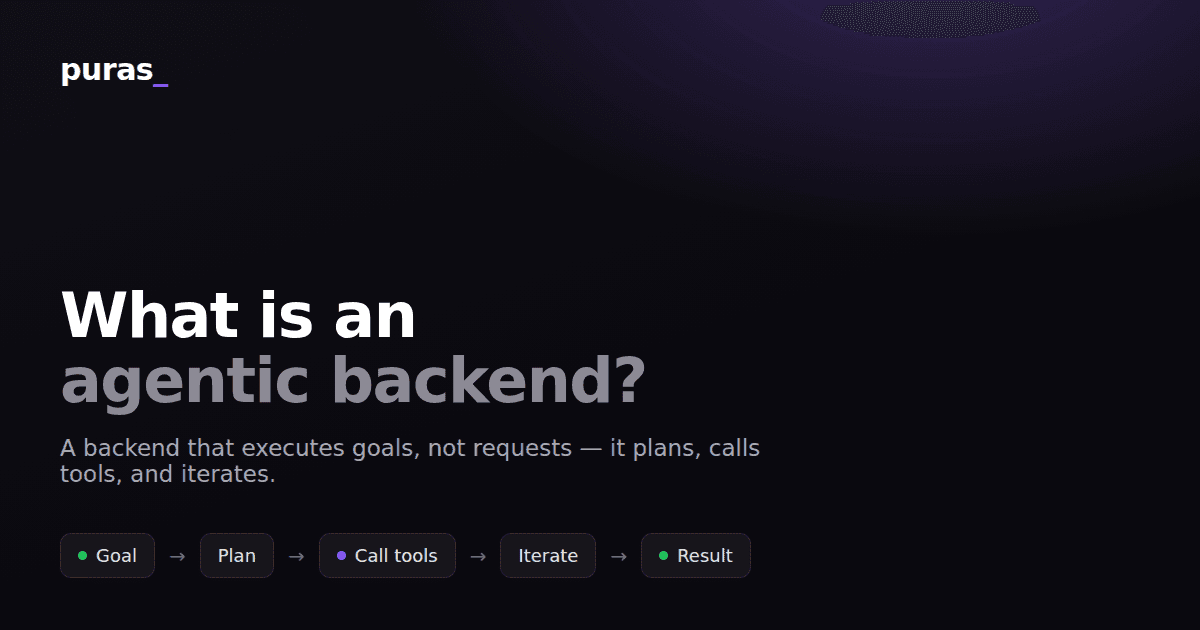
It's also the most expensive, slowest, and least reliable way to get an answer. An agentic backend exists to do the opposite, and that contrast is the clearest way to explain why you'd want one. (New to the concept? Start with what an agentic backend is.)
The "dump everything into one prompt" trap
Stuffing all your context into a single call has three failure modes that get worse as you scale:
It's expensive. You pay per token, every time. Paste a 200-page manual (roughly 150K tokens) into the prompt to answer one question, and you pay for all 200 pages on every single request — even though the answer lived on one page. That can cost dozens of times more than retrieving the single page that held it. Multiply by production traffic and the bill scales with your waste, not your value.
It's slow. A model has to read everything you give it before it produces the first token of output — the prefill cost. A bloated prompt means a long wait for an answer that a focused prompt would have returned in a fraction of the time.
It's lossy. Models don't attend to a huge context evenly. Details buried in the middle get recalled less reliably — the "lost in the middle" effect. Newer long-context models soften it, but at scale it's still real: more context doesn't reliably mean more accuracy, and past a point it means less, because the signal you need is drowned in noise you didn't.
You end up paying the most to get the least reliable result.
What an agentic backend does instead
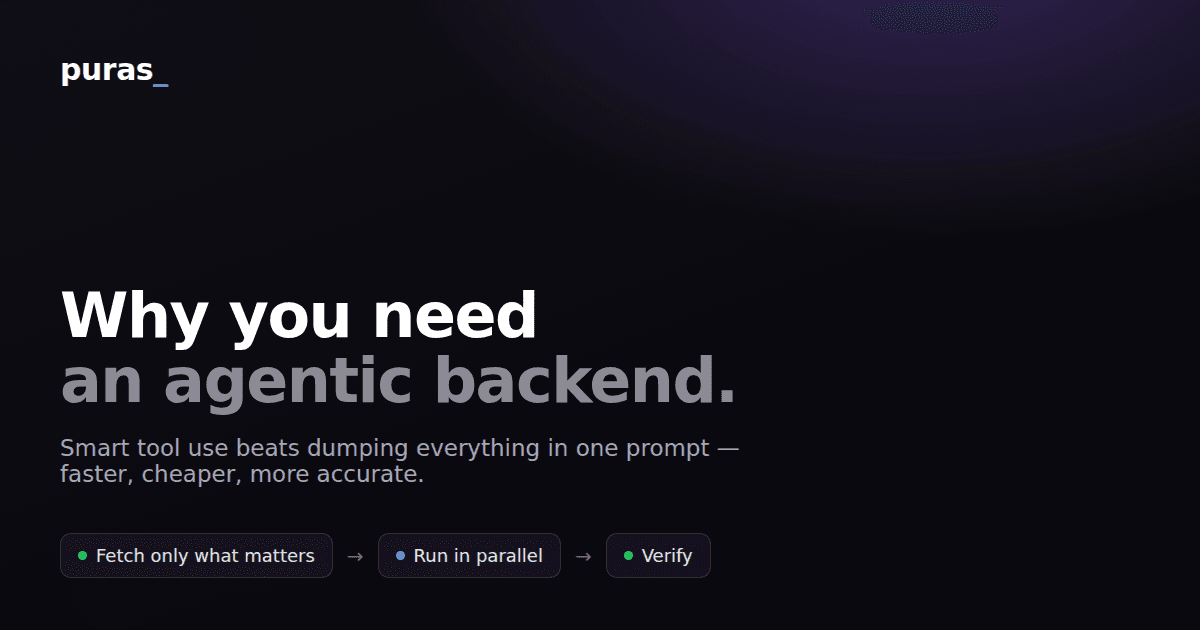
An agentic backend doesn't try to hold the whole world in one prompt. It uses smart tool use: it figures out what it actually needs, fetches only that, and works in focused steps. The model decides "I need the pricing section," queries for it, reads the small relevant slice, and acts. The context stays lean, every call stays cheap and fast, and the answer is grounded in the data it actually retrieved instead of buried in everything.
Here's why that approach wins, concretely:
1. It's cheaper, because you stop paying for tokens you don't use
Retrieval beats dumping. Pulling the three paragraphs that matter costs a tiny fraction of pasting the whole corpus, and you do it on demand instead of on every request. The model spends its budget reasoning, not re-reading reference material it didn't need.
2. It's faster, because work runs in focused, parallel steps
Small, targeted calls return quickly. And an agent can fan out — research three sources at once, generate four image variants in parallel, run independent subtasks simultaneously — then combine the results. A single monolithic prompt forces the work into one sequential pass; a pipeline of independent steps can run them concurrently. (Dependent steps still serialize — fan-out helps where the work genuinely splits.)
3. It's more accurate, because it can verify instead of guess
A single call answers from whatever's in the prompt and hopes it's right. An agent can check: run the code it wrote and see if it passes, open the URL and confirm the fact, render the output and confirm the file is valid, score its result against a rubric and retry if it falls short. Grounding an answer in an external tool result instead of in model memory is the difference between a confident guess and a checked one.
4. It can reach live, real-world data
Your one-shot prompt only knows what you pasted into it. An agent can search the web, fetch a page that changed an hour ago, read from a fresh database, or call an external API. The answer reflects the world now, not a frozen snapshot you had to assemble by hand in advance.
5. It does things a text completion simply can't
A lot of valuable work isn't text at all. Generating an image, rendering and captioning a video, transcribing audio, executing code, producing a file — none of these come out of a chat completion. An agentic backend treats these as tools the agent can call, so "produce a finished ad video" becomes a job it can actually complete, not a description it can only write about.
6. It remembers, so work done once isn't redone
A stateless call relearns your product from scratch every time. An agentic backend can carry memory across runs: what one job discovers about your brand, your catalog, your tone, the next job can query and reuse. Less repeated work, more consistency, lower cost over time.
7. It's observable and accountable
When something is wrong in a 100,000-token monolithic prompt, good luck finding where. A pipeline of discrete steps is debuggable: you can see which step fetched what, which tool returned what, where it went wrong, and what each model call cost. That visibility is the difference between a black box and a system you can operate.
How Puras delivers an agentic backend
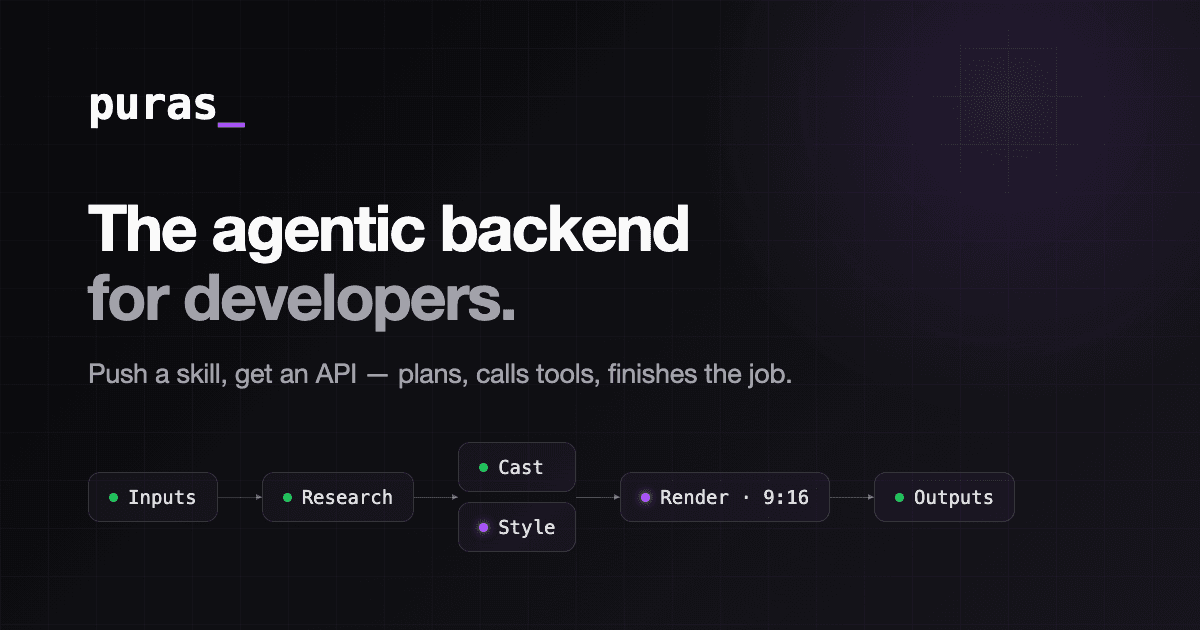
This is exactly the workload Puras is built to run. You write a skill — a prompt plus a typed contract — and Puras runs it server-side as a full agent with the smart-tool-use toolbox already wired in: shell, web, code execution, media generation, transcription, memory, and more. Every job streams as a live pipeline you can watch, and every model call shows up in a line-item cost breakdown. Secrets are write-only and scoped per skillpack, so your keys are never returned by the API.
It also keeps you flexible where the one-prompt approach locks you in. Any run can override the model with no redeploy, so adopting a faster or cheaper one is a one-line change (re-run your evals after the swap — a new model can shift behavior). And skills can declare evals — deterministic checks plus LLM-judge rubrics — so quality is a number you track over time, read as a trend across runs rather than a single verdict.
When you don't need one
If your task genuinely is one-shot — classify this string, summarize this paragraph, rewrite this sentence — a single LLM call is the right tool, and an agentic backend is overkill. Don't build a pipeline for a task that fits in a prompt.
The agent loop has real costs, too. Each act-observe step is a serial round-trip that adds latency, and a loop that fails to converge can burn tokens retrying — for a task that never needed iteration, a multi-step run can cost more than a single call. Bound your loops and cap retries. And if you already run your own agent infrastructure, a managed backend may not be the fit.
But the moment the work needs fresh data, multiple steps, real verification, or an output that isn't just text, the calculus flips hard. Dumping everything into one prompt asks the model to do impossible work badly and bills you the most for it. An agentic backend with smart tool use does the right work, in the right order, at a fraction of the cost — and hands you a finished result instead of a hopeful guess.
Run a skill free in the playground to see the difference, or wire
your coding agent straight to it:
claude mcp add --transport http puras https://mcp.puras.co/mcp.
FAQ
Why do you need an agentic backend? Because dumping all your context into one prompt is expensive, slow, and lossy. An agentic backend retrieves only what it needs, runs steps in parallel, and verifies results — so you get faster, cheaper, more accurate output.
Is an agentic backend cheaper than one big prompt? Usually, yes. You pay for the tokens you actually use via retrieval instead of re-paying for the whole corpus on every request. The exception is a genuinely one-shot task, where a single call is cheaper than a loop.
When do you NOT need an agentic backend? When the task is genuinely one-shot — classify, summarize, rewrite. A single LLM call is the right tool there, and a multi-step loop just adds latency and cost.