For most of its history, "backend" has meant one thing: a server that takes a request, runs the logic you wrote, touches a database, and returns a response. Predictable in, predictable out. An agentic backend breaks that contract on purpose. Instead of executing the steps you coded, it executes a goal you described — and figures out the steps itself.
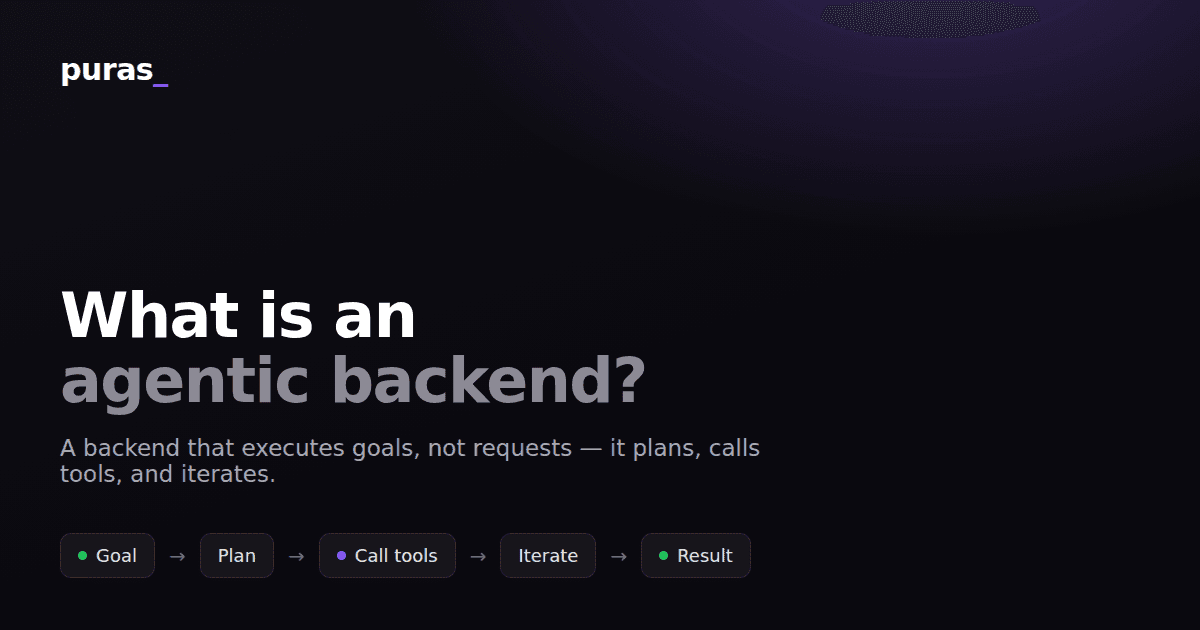
So, what is an agentic backend? In short: a server that runs AI agents — long-running jobs that plan, call tools, and iterate to a finished result. That reframing is bigger than it sounds. It changes what you write, how long a request runs, and what a "result" even is.
A traditional backend executes requests. An agentic backend executes goals.
In a normal software backend, you are the planner. You decide the order of
operations: validate the input, call the payments API, write a row, send the
email, return 200. The machine never improvises — if a case isn't in your
code, it doesn't happen. That determinism is the whole point. It's why banking,
checkout flows, and CRUD apps are built this way and should stay that way.
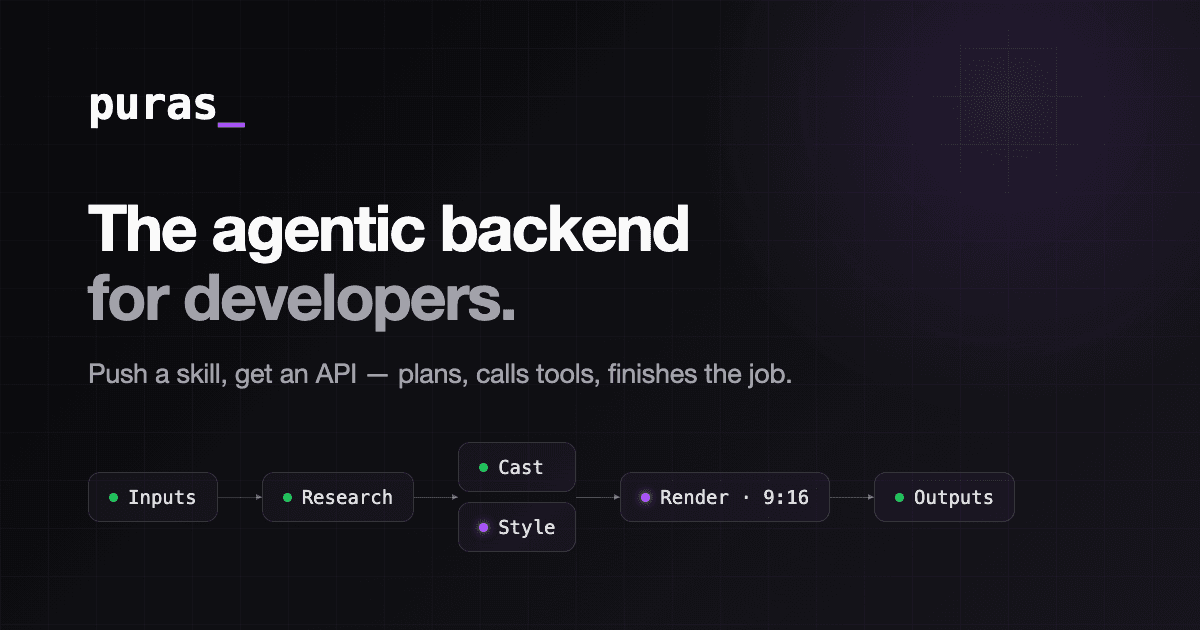
An agentic backend inverts the relationship. You hand it an objective — "research this product and produce a finished, captioned video ad" — and a typed contract describing what goes in and what must come out. The system then plans a route to that objective, calls tools along the way, inspects the results, and iterates until the contract is satisfied. The control flow isn't written in advance; it's generated, per run, by a model reasoning about the task.
So the difference from a traditional backend isn't "it has AI in it." It's where the logic lives. In software backends, logic is code you author. In agentic backends, logic is a strategy the system discovers at runtime. That tradeoff is real: a generated control flow is non-deterministic, so it has to be constrained — with typed contracts, evals, and confirmation gates — to be safe to ship in production.
Why a single LLM call stopped being enough
The first wave of AI features was simple: take the user's text, send it to a model, return the completion. Summarize this. Classify that. Rewrite this email. For those tasks, one call in and one response out is exactly right.
It breaks down the moment the task needs to do something rather than say something. A single completion has hard limitations:
- It has no persistent state. The model remembers nothing between calls — any continuity has to be re-supplied in the prompt, and it can't build on its own earlier work.
- On its own, it can't reach the world. Without tools wired in, a completion only knows its training data plus whatever you paste in — it can't open a live URL, run code, render a video, or check whether its own answer is correct.
- It answers in one shot. There's no room to try, observe the result, and correct course. If the first attempt is wrong, you get a confident wrong answer, not a fixed one.
Real work rarely fits in one shot. "Build a cited research report" means search, read sources, cross-check claims, discard the bad ones, and assemble the rest. "Turn a store listing into an ad" means fetch the page, pull the product facts, generate images, render the video, burn captions, and confirm the output is valid. None of that is a single completion. It's a loop: act, observe, decide, repeat.
That loop is multi-step reasoning, and it's the reason agentic backends exist. The model isn't just generating text — it's choosing the next tool to call, reading what came back, and deciding whether it's done. The "intelligence" isn't in any one call. It's in the loop around the calls. (For the cost, speed, and accuracy case for working this way, see why you need an agentic backend.)
What runs inside an agentic backend
Concretely, an agentic backend gives a job a place to run for minutes instead of milliseconds, with the machinery already built:
- An agent loop that plans and decides when the work is finished.
- Tools the agent can call: a shell, web search and fetch, screenshots, file read/write, code execution, media generation, transcription, even other agents as subroutines.
- Storage and memory so a run can produce files and so what one job learns is available to the next.
- Billing and observability so every model call is metered and visible, not a black box that returns an opaque blob.
Your app doesn't orchestrate any of this. It submits a job and reads the result, the same way it would call any other API.
What this is at Puras
Puras is an
agentic backend-as-a-service, and it
reduces the whole idea to one primitive: the skill. A skill is a prompt plus
a typed input/output contract. You
deploy it, and Puras runs it server-side as a full
agent — it plans, calls tools, and iterates until there's a finished result that
matches the contract. You call it like any other endpoint: one key, one POST,
any app. Your coding agent can drive the whole loop directly through the hosted
MCP server at mcp.puras.co — nothing to install.
The same submission API runs two kinds of work. Point a skill's entrypoint at a Markdown file and the worker runs an agentic loop with that file as its system prompt, with all the built-in tools available. Point it at a Python function instead and it runs deterministic code in an isolated subprocess — no model in the loop. Both deploy, bill, and stream identically. You reach for the agentic path when the task needs judgment, and the deterministic path when it doesn't.
Around that primitive sits the backend you stop maintaining: per-run file storage, a shared workspace memory (what one skill learns, the next can query and reuse), write-only secrets, versioned and immutable deployments, a live pipeline view of every job, and a per-call cost breakdown. You're charged per job, by what it actually uses.
What companies are actually solving with this
The pattern shows up wherever a task is too open-ended to hard-code but too valuable to leave to a single prompt. Teams are using agentic backends to:
- Generate marketing assets end to end — researched static ads, UGC-style videos, product reveal clips, landing pages — from nothing but a product URL.
- Run deep research that searches, reads, verifies, and returns a cited report instead of a paragraph of plausible-sounding text.
- Repurpose one piece of content natively across several platforms at once.
- Build playable, ready-to-ship artifacts like HTML5 mini-game ads from a logo and a handful of sprites.
What ties them together is that the customer doesn't want an answer — they want a finished thing. Producing a finished thing reliably takes planning, tools, and iteration. That's the job an agentic backend was built for — and, increasingly, the job "backend" means.
Try it
Browse the public skills and run one free in the in-browser
playground, or connect your coding agent and deploy your own:
claude mcp add --transport http puras https://mcp.puras.co/mcp.
FAQ
What is an agentic backend? A backend that runs AI agents server-side — long-running jobs that plan, call tools, and iterate to a finished result — instead of executing pre-written request/response code.
How is an agentic backend different from a regular backend? A traditional backend executes steps you coded; an agentic backend executes a goal you described and generates the steps per run, then validates the output against a typed contract.
Is an agentic backend just an LLM API call? No. A single LLM call is stateless, can't reach live data on its own, and answers in one shot. An agentic backend wraps the model in a tool-calling loop with storage, memory, and iteration so it can finish real work.